
Showing posts with label FUE Hair transplant. Show all posts
Showing posts with label FUE Hair transplant. Show all posts
Tuesday, October 20, 2015

Friday, September 18, 2015
Major FUE instruments of the hair transplant and their usage
Latest developments in instrument technology and improvements have now
made the complicated follicular unit extraction (FUE) a method competitive with
the common strip harvesting procedure for getting natural donor hair for the
transplantation surgery.
In FUE method, a surgeon removes one particular FU - or follicular
unit, at one time, aiming those grafts that appear most possible to increase
and produce natural hair in a recipient site. It needs more ability of the
surgeon and more charge from the transplant patient compare to the strip
harvesting method. The FUE is an advanced and safer method than strip
harvesting technique. Here are some FUE instruments, which are used for the FUE
technique.
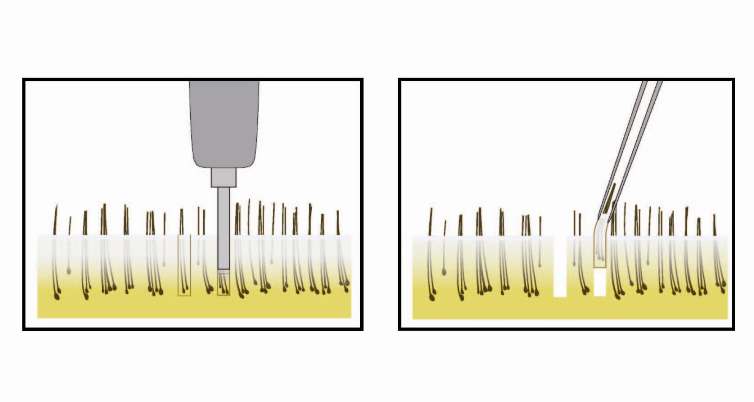
The Manual Punch Tool: The manual punch Tool is a round hollow sharp
scalpel with a total diameter of 0.7 to 1.2 millimeter. This tool is the
original FUE instrument. The tool’s punch is positioned over the visible part
of a follicular unit's hair on the scalp, and pushed downward with normal
manual rotation to cut the skin around the follicular unit and properly free it
from surrounding hair tissue. The follicular unit is then extracted by the
forceps.
The SAFE System: A special three-step manual procedure called The SAFE
System. In the first step, it utilizes a sharp round punch to cut the skin
around the follicular unit, now in a second step, a special blunt circular
punch to release the follicular unit from surrounding tissue and in the last
step is extraction.
Powered SafeScribe® Tool: The Powered SafeScribe® Tool is a handheld
electronic gadget to remove the follicular units from the donor area with the
minimal possibility of damage, and reserve for transplantation. A wide range of
different punch sizes and types is easily available in the market. In skilled
hands, this tool can decrease the total time of FU extraction procedure
sessions, decrease the possibility of scarring, and give a high rate of intact
FUs.
RotoCore Tool: This tool automatically rotates over the FUE as it cuts
the skin around the follicle. The tool permits the surgeon to pre-set the punch
to incise to a selected depth.
The Feller Instrument Tool: The tool combines complicated FUE procedures into a solo instrument to assist the surgeon work faster and more
professionally.
NeoGraft Tool: This is a motorized device that gives a rotating sharp
punch to cut the follicular unit, and a suction tool that extracts the FUE
safely for the hair transplant surgery.
Wednesday, April 1, 2015
FUT VS FUE
Hair
transplantation field has gone through several changes in past few years.
Various hair transplant clinics and centers have been using a number of methods
but FUT and FUE are most widely used hair transplant techniques that include transferring
individual follicular units in their genetic form. Follicular Unit
Transplantation is considered as traditional hair transplant methods that has
now replaced by Follicular Unit Extraction. The basic difference between both
procedures lies in extraction method while implanting process is almost same in
both type of hair transplantation.
FUE is
advancement in Follicular Unit Transplantation in which hair are extracted from
donor area in the form of follicular units. Follicular units are group of three
to four hair. A small needle punch is utilized to separate follicular units
from the surrounding tissue and creates small circular incision in the skin.
The follicular Unit is then extracted directly from scalp which leaves a small
open hole. Then, follicular units are placed onto recipient sites.
Follicular
Unit Transplantation (FUT) involves extraction of strip of hair and tissue from
back of the scalp. The, hair transplant surgeons dissect hair bearing strip
into individual follicular units. The dissection is done under fiber optic
equipped microscopes to prevent the application of heat to the grafts. Then,
they are implanted onto bald region where the surgeon has made recipient sites.
The suture or staple are used to close the wounds.
FUE has
a number of advantages over FUT hair transplant as it does not result in linear
scarring. The healing time is fast. With minimally invasive nature, it produces
hundreds of tiny scars in the donor area that are hard to detect.
FUE
hair transplant is the most refined approach to hair transplantation and best
for those who want to wear short hairstyle or scalp is too tight or has
existing damage. Pain and discomfort in FUE after the surgery is less as
compared FUT hair transplant.
FUE can
be repeated after one month but FUT cannot because it takes much recovery time.
FUE is length and time consuming process and requires experienced and trained
hair transplantation surgeons and standardized instruments.
Wednesday, November 12, 2014
Comparative Study between different techniques of FUE Hair Transplant
Hair
transplant techniques have improved significantly in the course of time. with
the help on cutting edge technology and latest advancements in the information
technology sector, scientists have employed this along with the most diverse
knowledge of the process of hair loss; resulting in more advanced techniques
which give promising results. The chronological placement of these techniques
place FUT at the bottom of pyramid.
FUT was the breakthrough that mankind was
waiting for a long time. at that time, it was the dream treatment that one
could get and people used to opt it significantly despite of the risk of
getting scars in the donor area which were irreplaceable.
FUT
did its job as the one and only permanent solution to hair loss for as long as
there was not any significant procedure developed to succeed this method. Then
came along the modern gold standard of hair transplant surgery. FUE involves
removal of singular hair follicle and this basic unit is then transplanted into
the donor area. This had many advantages for the person who is getting his hair
transplanted as well as the surgeon who is performing this technique. Minimal
invasive technique was the name called to FUE and hence it promised minimal
scars in the donor area leaving it natural looking and without any bizarre
marks that the patient had to hide afterwards.
With
the passage of time, a need of more
enhanced surgical procedure was felt. This led to the development of
large scale FUE and another procedure which comprised of combination of FUE and
FUT side by side. Large scale FUE is used to implant larger number of hair
follicles in a single surgery and hence the need of multiple surgeries is
eliminated. Also the tools used for excision, separation and transplantation of
hair follicles are now more precise and smaller in size. This has also
minimized the duration of recovery and that is why the transplanted follicles
start to grow and cover the once bald spots rapidly.
Newly developed software
also help FUE practicing surgeons to develop a simulated version of the
resulting scalp which allows the hair transplant surgeon to foresee and complication that may
arise beforehand . FUE techniques and the newly incorporated changes in the
basic process work hand in hand and hence it is hard to tell one from the other
on the basis of efficiency. It depends on the best judgment of the surgeon and
the severity of the case which leads to the selection of particular FUE
technique to be used.
Subscribe to:
Posts (Atom)